One resistor, one capacitor, and a knob that's lying to you: how an analog EQ actually works
Forget the mixing tips. This is the electronics: what really happens when you sweep a mid, why a Pultec can boost and cut the same note at once, and the op-amp cheat hiding inside almost every console built since 1970.
Forget the mixing tips. This is the electronics. What is really happening to the signal when you sweep a mid, why a Pultec can boost and cut the same note at the same time, and the op-amp cheat hiding inside almost every console built since 1970. Evergreen.
You reach up to the third channel on the desk. The vocal is boxy, that honky thing around 500 that lives in every SM58 into every wedge you've ever stood behind. You grab the low-mid frequency knob, sweep it until the box gets worse, park it there, then pull the gain down four dB. The box leaves. The vocal sits.
You did that in about three seconds and you didn't think about it once.
Here's the thing nobody tells you at the start. That knob you turned is not connected to the frequency. There is no wire inside the console that runs to "500 Hz." There is no little gate that opens and lets 500 through and holds everything else back. What you turned was a variable resistor, and what it changed was the value of a resistance in a small network of parts, and that changed where a curve sits, and the curve did the rest. The knob is a stand-in. The label on the panel is a promise the electronics keep by a completely different route than the one the label implies.
Most working engineers will run EQ every day for a whole career without ever seeing what's under the knob. You don't need to. The desk works. But the reason a Neve sounds like a Neve and an SSL sounds like an SSL and a Pultec does that thing to a kick drum that no plugin quite nails, all of that lives in the parts under the panel. The character you're chasing when you argue about consoles is the character of about a dozen components and the specific way somebody wired them in 1968, or 1979, or last Tuesday. So let's go under the knob. No math you can't do in your head. Just the actual electronics, the actual parts, and what actually moves when you turn the thing.
There is no volume knob for a frequency
Start with what a signal even is, because everything follows from it.
The audio coming down the cable is a voltage that goes up and down. That's it. A microphone turned air pressure into a wiggling voltage, and now that voltage is wiggling its way through your console. When we say a sound has a low frequency, we mean the voltage is wiggling slowly. High frequency, wiggling fast. A kick drum fundamental at 60 Hz is the voltage swinging up and down sixty times a second. A cymbal's air at 12 kHz is the same voltage doing twelve thousand swings in that same second, riding on top of everything else at the same time.
Real audio is never one frequency. It's hundreds of them stacked on top of each other, all summed into one voltage that's wiggling in a complicated way. The snare hit you're EQing is low-frequency swings and high-frequency swings and everything between, all added together into a single line of voltage moving through a single wire.
Now here's the constraint that shapes every EQ ever built. You cannot reach into that summed voltage and grab one frequency. There's no handle on it. The 500 Hz and the 5 kHz are not in separate places you can get to. They're the same voltage, at the same instant, on the same wire. Anything you want to do to one frequency, you have to do with a circuit that treats fast wiggles differently from slow wiggles, and then only turn up or down whatever that circuit happened to catch.
That's the whole game. An equalizer is not a machine that finds frequencies. An equalizer is a thing that has a different amount of gain at different speeds of wiggle. You build a circuit that naturally lets some wiggle-speeds through more than others, and then you adjust how much. That is all EQ is, from the tone knob on a fifty-dollar guitar amp to a mastering desk that costs more than a house. Frequency-dependent gain. Some speeds louder, some speeds quieter, and a knob to set how much.
So the real question is a parts question. What component treats fast voltage differently from slow voltage? Because whatever that part is, it's the beating heart of every EQ on earth. And it turns out there are only three of them.
The two parts that start everything
A resistor is the boring one, and I mean that as a compliment. A resistor opposes current the same amount no matter what. Slow wiggle, fast wiggle, doesn't care. It just knocks the level down by a fixed proportion. On its own it can make things quieter, and nothing else. Useful, but frequency-blind.
The capacitor is where it gets interesting. A capacitor is two plates with a gap. It passes a wiggling voltage by charging and discharging, and here's the part that matters: it's better at passing fast wiggles than slow ones. Push a high frequency at a cap and it barely notices the gap, current flows, signal passes. Push a low frequency at the same cap and it fights you, because there's time for the plates to fully charge and stall the flow. The cap's opposition to signal, we call reactance, and it climbs as frequency drops. Low notes see a big obstacle. High notes see almost nothing.
That's the first frequency-dependent part. And the moment you have a part that treats highs and lows differently, you can build a filter.
Put a capacitor in series with the signal, then a resistor from the signal path down to ground, and you've built a high-pass filter. The cap fights the low frequencies and lets the highs sail through. Whatever lows do squeak past the cap get bled off to ground through the resistor. Result: lows come out quieter, highs come out fine. You just built the low-cut button on every channel of your console. It is genuinely that simple. A cap and a resistor.
Flip the two parts, resistor in series and cap to ground, and you get the opposite. The highs now find an easy path to ground through the cap and disappear, the lows come through. A low-pass filter. The tone knob rolled all the way down on a bass.
Where does the filter "turn over"? At the frequency where the capacitor's reactance equals the resistor's resistance, because that's the crossover point where the two parts are fighting equally. And that point has a formula, the one number worth carrying in your head for the rest of this:
f = 1 / (2π R C)
Frequency of the corner equals one over two-pi times the resistance times the capacitance. You don't have to compute it. You have to notice what it says. The corner frequency depends on R and on C. Change either one and the corner moves. Make the resistor bigger, the corner drops lower. Make it smaller, the corner climbs.
And there's the trick that runs the whole console. A knob on the front panel, the one that says "frequency," is very often just a variable resistor, a pot, sitting in the R slot of that formula. When you turn the low-cut frequency knob from 40 up to 120, you are physically changing a resistance, which moves the corner of exactly this filter. The knob says Hz. The knob is a resistor. The Hz is what the resistor does to the corner in that formula. That gap, between what the label claims and what the part is, is the reason this article exists.
One more thing about this basic filter, because it explains a limit you bump into constantly. A single cap-and-resistor filter rolls off at six dB per octave. Octave meaning a doubling of frequency. So the simplest low-cut, one octave below its corner, is only down six dB. That's a gentle slope. It's why the low-cut on a lot of desks feels polite, and why when you want a brick wall you're reaching for something steeper. Steeper just means more of these stages stacked in a row. Two stages, twelve dB per octave. Three stages, eighteen. Every steep filter is just gentle filters holding hands.
Four shapes, and that's the entire vocabulary
Cutting is easy. A cap bleeds a range to ground, done. The harder move is boosting, because a resistor and a cap can only ever throw signal away. To make a frequency louder than it came in, you need gain, and gain means an active part. An amplifier. A tube, a transistor, or the workhorse of modern analog, the op-amp, which is just a tiny amplifier-on-a-chip that does exactly what the surrounding parts tell it to.
Here's the elegant idea that runs almost all active EQ, and it's worth slowing down for. You take an amplifier and you wrap a filter into its feedback loop, the path that runs from the output back to the input. Feedback is what sets an amplifier's gain in the first place. Now make that feedback path frequency-dependent by putting caps in it. Suddenly the amplifier has a different amount of gain at different frequencies, because the thing controlling its gain now behaves differently for fast and slow wiggles. Set it up one way and the amp boosts a band. Flip the same network and it cuts the same band. One circuit, boost and cut, just by which way the parts lean.
That's the Baxandall arrangement, and it's the grandparent of nearly every tone control you've ever touched. Peter Baxandall, a British engineer, published it in 1952, a bass-and-treble control using negative feedback that let you swing each end up or down independently and smoothly, with low distortion, no clunky switches. The bass and treble knobs on hi-fi gear, the two-band EQ on a small mixer, the broad shelves on a channel strip, most of them trace straight back to that 1952 paper. When people call an EQ "musical" or "smooth," a lot of the time they're describing the gentle, wide, low-distortion behavior that falls naturally out of a Baxandall-style feedback network.
So what shapes can you actually make? Four, really. Learn these four and you've learned the whole visual language of every EQ display and every console panel.
A high-pass, or low-cut, which we already built: everything above a corner passes, everything below rolls away. Its mirror, a low-pass. A shelf, which is the Baxandall move: everything past a turnover frequency gets lifted or dropped by a set amount and then levels off, like a step up or down in the response, a shelf you've raised the whole far end onto. Low shelf for the bottom, high shelf for the top. And the bell, sometimes called peak, a bump or a dip centered on a frequency that returns to normal on both sides. The bell is the one you sweep. That low-mid box-hunt at the top of this piece was a bell.
Every EQ you'll ever run is some combination of those four shapes, each one steered by a knob, and each knob is quietly doing one of two things underneath. Either it's a variable resistor moving a corner or turnover frequency by sitting in that f = 1/(2πRC) formula, or it's a variable resistor setting how much of the filtered signal gets fed back, which sets the amount of boost or cut. Frequency knobs move corners. Gain knobs set amounts. Same part, a pot, doing two different jobs depending on where in the network it sits.
Three of those four shapes, though, we can already build with resistors and caps. The high-pass, the low-pass, the shelves. The bell is different. The bell needs something the other shapes don't, and that something is the most interesting part in the whole box.
Q, or how wide is the wound
Before we get to the bell's secret ingredient, we need the word that describes it: Q.
When you make a bell, you're boosting a band around a center frequency. How wide is that band? A gentle, broad hill that lifts a whole region, or a narrow spike that grabs one nasty resonance and nothing around it? That width is Q. Formally, Q is the center frequency divided by the bandwidth. The math falls out clean: high Q means the bandwidth is a small slice of the center frequency, so a narrow, focused bell. Low Q means a wide bandwidth, a broad, gentle curve.
In the room this is the difference between a tool and a scalpel. Low Q, say around 0.7, is what you want when a mix just needs more air or more weight, a wide flattering tilt you don't really hear as "EQ." High Q, up around 6 or 8, is for surgery: the ring in a tom, the 2 kHz ice pick in a cheap cymbal mic, the one feedback frequency that's about to ruin your monitor mix. Narrow enough and you can pull out a single offending note and leave its neighbors alone.
Here's a detail that separates desks and that most people never connect to the electronics. On some EQs the Q is fixed. You get the same width whether you boost two dB or twelve. On others the Q changes with how hard you push, and it changes on its own, because of how the circuit is built rather than because of a knob. Small boost, wide and gentle. Big boost, and the bell tightens up automatically. We'll come back to why that happens and why people swear it's the secret sauce of certain classic units. For now just hold onto the idea that width can be fixed or it can move, and that difference is baked into the parts.
The coil in the box, and the op-amp that replaced it
To make a bell, a proper resonant bump centered on a frequency, you need a circuit that rings. Something that has a natural frequency it wants to emphasize, the way a bell or a wine glass has a note it prefers when you tap it. Caps and resistors alone don't ring. They just roll off. To get resonance you need the third and last frequency-dependent part: the inductor.
An inductor is a coil of wire, and it's the mirror image of a capacitor. Where a cap passes highs and fights lows, a coil passes lows and fights highs. Its opposition climbs as frequency rises. And when you put a coil and a cap together, something magic happens. There's one frequency where the coil's rising opposition and the cap's falling opposition meet and cancel in just the right way, and the pair resonates. That meeting point is the tuned frequency, and it has its own formula, a cousin of the one from before:
f = 1 / (2π √(L C))
The tuned frequency depends on the inductance L and the capacitance C. Pick the coil and the cap, you've picked the note the circuit rings at. Wrap that resonant pair into a feedback loop and you've got a bell that boosts or cuts right at that note. This is how the classic desks made their midrange. Real coils, real iron, wound on the bench.
This is the Neve sound, in a real physical sense. A 1073, the module people build entire studios around, uses inductors in its EQ. So does an API 550. So did a Pultec. When you hear that those EQs have a "thick" or "colored" or "sweet" midrange, you are partly hearing coils. Because here's the catch with real inductors, and the catch is the whole story: a coil is not a clean, ideal part. It's a physical hunk of wire around a core, and it has personality whether you want it or not.
Coils pick up hum. Wave a coil near a power transformer and it acts like a little antenna for the fifty or sixty cycle field radiating off the mains, which is why old consoles have their inductors tucked and shielded and oriented just so. Coils have resistance in the wire itself, which bleeds off some signal. And the core, the iron or ferrite the wire wraps around, doesn't respond in a perfectly straight line when you drive it hard. Push a lot of level through and the core starts to saturate, adding a little harmonic thickness, a compression, a bloom on the loud bits. That nonlinearity is technically an error. It's the coil failing to be a perfect part. And it is exactly, precisely the thing people pay thousands of dollars to get. The "magic" of a vintage inductor EQ is in large part the sound of a component not quite doing its job.
Coils have one more problem, a practical one that changed the whole industry. They're big, they're heavy, they're expensive to wind, and you can't easily make one adjustable. You want to sweep the frequency of an inductor-based bell? You can't just turn a knob, because the coil's value is fixed by its physical windings. On the old desks, changing the EQ frequency meant a rotary switch clunking between separate fixed coils and caps, which is why a Pultec or an old Neve gives you a switch with a handful of frequencies rather than a smooth sweep. Every frequency is a different physical part getting switched in.
So somewhere around the late 1960s and into the 70s, as op-amps got cheap and good, designers pulled a genuinely clever trick. They faked the coil.
The circuit is called a gyrator, and it does something that sounds like a magic act: it takes a capacitor and, using an op-amp and a couple of resistors, makes that capacitor behave, at its terminals, exactly like an inductor. The op-amp flips the capacitor's behavior inside out. From the outside, the rest of the circuit can't tell it isn't a real coil. It rings at a tuned frequency with a cap just the same. And the value of that fake inductance is set by, of all the friendly things, the resistors: roughly the two resistors multiplied by the capacitor. L is about R1 times R2 times C1.
Read what that buys you. No coil means no hum pickup, so no shielding gymnastics. No heavy iron, so it's tiny and cheap. And because the "inductance" is now set by a resistor, you can make that resistor a pot and sweep the frequency smoothly with a knob, the thing real coils could never do without a machine shop and a fistful of switches. The gyrator is why your console has a smooth, continuous frequency sweep on the mids instead of a clunky switch. It's why a graphic EQ can cram thirty-one bands into a rack space instead of thirty-one heavy coils. It's why the parametric on your channel strip exists at all.
This is the single biggest divide in analog EQ, and now you can hear it for what it is. Inductor EQs, the Neves and APIs and Pultecs, use real coils, with all the size, cost, hum, and glorious nonlinear color that comes with them. Gyrator EQs, the SSLs and most every console and outboard unit from the 70s on, use op-amps faking coils, which is cleaner, cheaper, endlessly tweakable, and, some would say, a touch more clinical. An SSL 4000 channel EQ, the sound of a thousand records, is gyrators. Its reputation for being surgical, precise, a little aggressive when you push it, that's the fingerprint of op-amp-simulated resonance versus real iron. Neither is better. They're two different answers to the same problem: how do you make a circuit ring without the coil being a pain.
The Pultec paradox: boosting and cutting the same note at once
Now the party trick, because it's the best illustration of why understanding the parts changes how you use the box.
The Pultec EQP-1A is a passive equalizer. Passive meaning it has no gain of its own in the EQ section, just coils, caps, and resistors bleeding energy away. And passive circuits have a problem: throwing signal away means the whole thing comes out quieter, a loss of around sixteen dB just from the network sitting in the path. So the Pultec bolts a tube makeup amplifier onto the back to shove the level back up to where it started. That tube stage, driven hard, is a good chunk of the Pultec's famous warmth, but it's a passenger. The EQ shaping happens in the passive coils and caps up front, and the tube just pays back the volume the passive network stole.
The famous move is this. On the low-frequency section, the Pultec gives you a boost knob and an attenuate knob, and they're on the same frequency band. Every manual and every old engineer will tell you never to use both at once, it's illogical, they'd just cancel. And every record you love ignores that and turns both up anyway.
Here's why it works, and it's pure parts. The boost control and the cut control don't act on exactly the same curve. The boost lifts a broad low-frequency bump. The cut pulls down a shelf that bites a little higher in frequency than the boost's peak. So when you run both, the boost gives you weight down at the bottom, say a lift centered around 60 Hz, while the cut scoops out the lower midrange just above it, the 200 to 500 region where mud and boxiness live. The two curves overlap but they're not identical, so they don't cancel. They combine into a shape you couldn't dial any other way with those knobs: a bump at the very bottom and a dip just above it.
Weight and clarity at the same time. That's why a Pultec makes kick drums and bass sound huge but not muddy. It's not a mystery and it's not tube fairy dust. It's two overlapping curves with slightly offset centers, summing into something neither knob could make alone. Once you can see the two curves, the "forbidden" trick stops being folklore and becomes obvious. You're not fighting yourself. You're carving a notch of space right above a mountain of low end.
That is the payoff of going under the knob. The trick that looks like breaking the rules is just the parts doing exactly what the parts do, and knowing the parts tells you why it sounds good instead of leaving you to cargo-cult a setting off a forum.
Why two EQs at the same numbers sound different
Set a plugin and a real console to the identical frequency, gain, and Q, and they will not sound the same. This drives newcomers crazy and it's completely real. The reasons all live in the parts, and now you have the vocabulary for every one of them.
Tolerances. Every resistor and cap has a stated value and a real value, and the real one is off by a percent or a few. A "500 Hz" band built from real parts might actually center at 470 or 540. Multiply that across every component in a channel, then across every channel in the desk, and no two strips are truly identical. That slop, the fact that nothing is exactly on its label, is part of why old consoles have a hand-built, slightly uneven character that a mathematically perfect plugin has to go out of its way to fake.
Nonlinearity, the coil and transformer story from before. Real inductors saturate. Transformers, which sit at the inputs and outputs of a lot of classic gear, add their own harmonic thickness and a gentle limiting on transients. None of that shows up in the frequency setting. All of it shows up in your ears. When a Neve "sounds like a Neve" even set flat, that's the transformers and the iron coloring the signal on the way through, before the EQ does anything at all.
Q behavior, the thing I promised to come back to. On a lot of the classic inductor EQs, the API 550 being the poster child, the Q isn't fixed. Boost a little and the bell is wide and gentle. Boost a lot and it tightens up on its own. This is called proportional Q, and it falls out of how the resonant circuit interacts with the gain stage as you push it. You don't set it. The circuit does it for you.
And it happens to match how people actually want to use EQ. Small tweaks stay broad and invisible. Big moves get focused, so a heavy boost surgically grabs its target instead of ballooning out and taking the whole neighborhood with it. A huge part of the "these EQs just sound right, they're so musical" reputation is really this one behavior, the bandwidth automatically doing the sensible thing. Other designs use constant Q, where the width stays put no matter the gain, which is more predictable and more precise and, to a lot of ears, a little more clinical. Not worse. Just a different philosophy about whether the box should have opinions.
Then there's phase, the part that gets argued about most and understood least. Any EQ that boosts or cuts also shifts the timing of the frequencies around the move. This isn't a defect or a cheap-versus-expensive thing. It's a law. A normal analog EQ is what's called minimum phase, which means the phase shift is tied to the gain change and comes along for free whether you want it or not. Boost a band and the frequencies near it get nudged in time relative to their neighbors, a smearing that's tiny in absolute terms and gets more abrupt the higher the Q. Most of the time you can't hear a static phase shift on its own. But it's why a steep, high-Q boost can start to sound a little hollow or ringy, and it's why gentle, wide moves so often sound more natural. The wider the curve, the lazier the phase shift, the more the ear just reads it as tone rather than as something being done to the sound.
You can build an EQ that boosts without any phase shift. It's called linear phase, it only really exists in the digital world, and it buys that flat phase by delaying the signal and pre-ringing a hair before transients, its own kind of artifact. There's no free lunch. Analog trades a little phase smear for zero latency and zero pre-ring. Linear-phase digital trades latency and pre-ring for flat phase. Every EQ is paying for its behavior somewhere, and part of being good at this is knowing which bill you'd rather pay for the source in front of you.
Last stop, the endpoint of this whole evolution: the parametric. Once gyrators made frequency sweepable with a pot, and once you could make the Q adjustable too, you could hand the engineer independent control of all three at once. Frequency, gain, and Q, each on its own knob, each freely variable, no switches, no fixed bands. George Massenburg gets the credit for the fully realized version and for the name, in a paper he brought to an AES convention in 1972. The circuit underneath is usually a state-variable filter, a clever arrangement that spits out the filtered signal in a form where you really can twist frequency and Q without them fighting each other. The parametric is the most flexible EQ there is, and it's a direct descendant of the moment somebody decided a real coil was too much trouble and faked one with an op-amp.
What you can take back to the desk
You can run EQ for twenty years without any of this, and plenty of great engineers do. But knowing what's under the knob quietly changes how you reach for it. A few things worth carrying:
The low-cut is nearly free, so use it early and use it often. It's the simplest filter there is, a cap and a resistor, minimal phase cost when it's gentle, and it clears out subsonic junk and stage rumble that's eating headroom for no musical reason. Most channels on most desks want some.
Cut before you boost, when you can. Cutting is passive and undemanding. Boosting means driving a gain stage and dragging more phase shift along with it. The old habit of finding the ugly frequency and pulling it down, rather than hunting for a magic frequency to push up, is easier on the signal and usually easier on the ear. The vocal at the top of this piece got better because we took something away.
If you're on a proportional-Q desk, an API or a Neve or something voiced in that spirit, don't be shy with the gain. The circuit tightens the bell as you push, so a bold boost focuses itself instead of smearing. Timid two-dB moves don't show off what those EQs are for. They're built to be pushed.
The Pultec low-end trick is real, it's repeatable, and now you know why: boost and cut on the low band at once, and you get weight underneath with a scoop of mud just above. If you've got a passive EQ or a plugin that models one, kick and bass are what it's for.
Watch your Q on big boosts up top. Narrow, high-Q lifts in the presence region carry the most phase shift and the most chance of sounding brittle or ringy. Widen the Q and the same tonal move sits more naturally, because you've asked the circuit to bend time less abruptly to get there.
And when someone tells you their console sounds better than yours, you now know exactly what they're claiming. They're claiming their coils, their transformers, their tolerances, and their designer's choice about proportional Q add up to a character they like. That's a real thing. It's also a completely specific thing, made of about a dozen parts and one set of decisions, and not magic. The knob is still lying to you. But now you know the truth it's covering for, and you can hear the parts under the panel, which is where all of it was hiding the whole time.
Turn the knob. Bend the electrons. Now you know which ones.
— Above the Fader
Sauce
- Rod Elliott, "Equalisers — The Various Types And How They Work," Elliott Sound Products. Passive versus active, the RC corner, shelving versus peaking, Q and bandwidth, phase behavior.
- Rod Elliott, "Gyrator Filters (Simulated Inductors)," Elliott Sound Products. The op-amp simulated inductor, L ≈ R1·R2·C1, and how it shows up in graphic and parametric EQ.
- "Baxandall Tone Controls," Sweetwater inSync. P.J. Baxandall, 1952, Wireless World, and the low-distortion negative-feedback topology behind most tone controls.
- "Understanding the Pultec Equalizer," Ultimate Preset. The passive inductor-and-capacitor network, the tube makeup stage, and the simultaneous low-end boost and cut.
- George Massenburg (Wikipedia) and Massenburg, "Did Massenburg Really Invent the Parametric EQ?". The 1972 AES paper and where the word "parametric" comes from.
- API 550A product page. Inductor-based design and the proportional-Q behavior credited to Saul Walker.
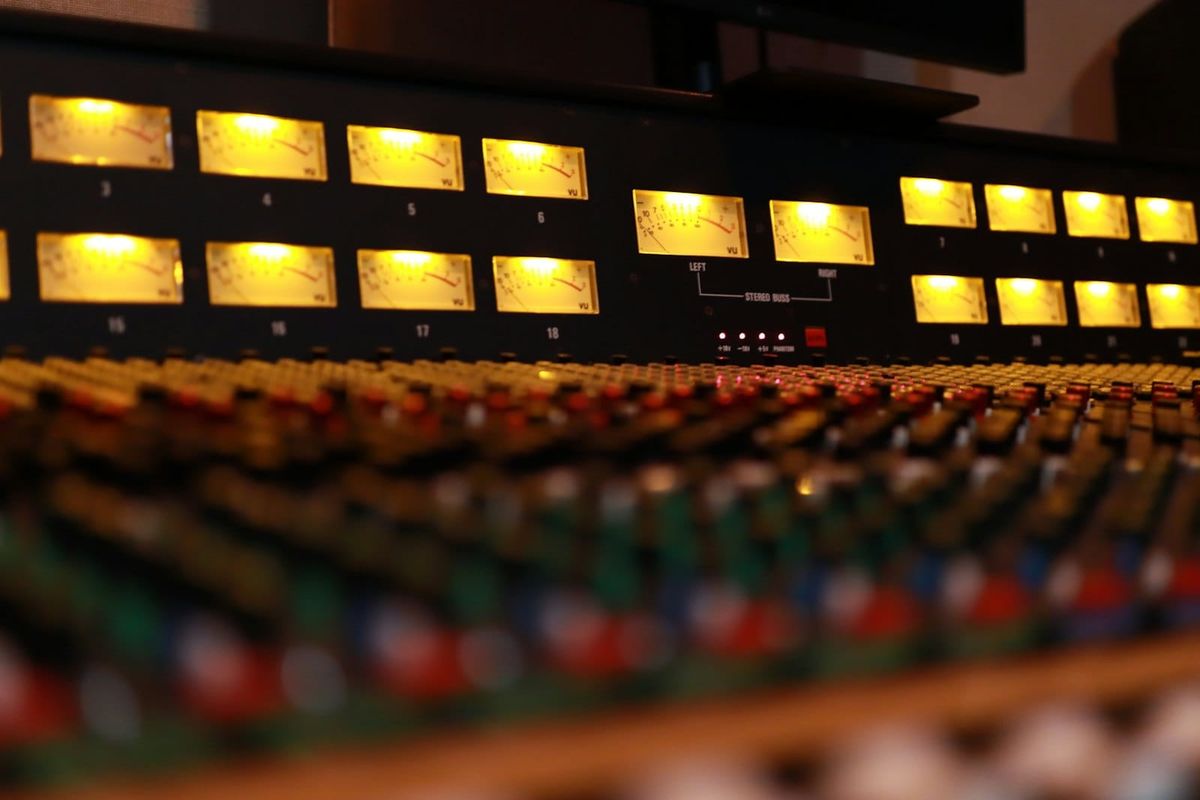
- Featured photo by Caught In Joy via Unsplash. Diagrams are ours, with the response curves computed from standard filter transfer functions.