Late on purpose
Delay towers, the speed of sound, and what "aligned" actually means a hundred meters from the stage.
Delay towers, the speed of sound, and what "aligned" actually means a hundred meters from the stage.
Walk out to the delay towers at 10:45 pm with a beer you're not supposed to have and listen. At 3 in the afternoon this field was perfect. You shot the towers with the analyzer, the impulse peaks stacked like pancakes, and for one golden hour a kid on a blanket 120 meters out heard the snare arrive once, from the stage, like nature intended. Now it's dark, the temperature has dropped eighteen degrees since soundcheck, and that same snare arrives twice. Not an echo exactly. A smear. The low mids have gone hollow in a way that moves when you walk, the vocal sits somewhere above the lighting towers, and the systech is staring at the processor like it betrayed him.
It didn't. Nothing in the rack changed. What changed is the air, because the one number every delay time in the rig is built on, the speed of sound, is not actually a constant. It's a weather report.
This week is about time: what it costs to move sound across a field, why we build towers instead of just turning the mains up, how the ear decides whether two arrivals are one sound or two, and why an alignment is a photograph of one atmospheric moment, not a property of the system. The math here is the cheapest in all of live sound, mostly multiplication, and it explains more bad outdoor shows than any EQ decision ever made.
The constant that isn't
Sound moves through air at a speed set by the gas itself: around 331.5 meters per second in dry air at 0 degrees C, climbing about 0.6 meters per second for every degree above that. At 20 degrees you get roughly 343 to 344 meters per second, which is the number everyone memorizes and then treats like a physical constant on the order of the speed of light.
It is not. It's a function with your gig in the domain. The handy working conversions at 20 degrees: sound covers a meter in about 2.9 milliseconds, a foot in about 0.9, so "a millisecond per foot" is close enough for shouting across the field, and 2.9 milliseconds per meter is the number to actually type into the calculator. A delay tower 80 meters from the main hangs needs its signal held back roughly 233 milliseconds just to break even with the air, before any of the deliberate offsets we'll get to later.
Now watch what temperature does to that. The 3 pm soundcheck happened at 30 degrees: 349 meters per second, so 100 meters of field costs 286.1 milliseconds. By the encore the field is at 12 degrees: 338.6 meters per second, and the same 100 meters costs 295.4 milliseconds. The air got slower by just over 9 milliseconds over that run, and your delay time, typed in at soundcheck and never touched again, is now wrong by that amount. Nine milliseconds is not a subtlety. It's three meters of error. It is the difference between a tower that disappears and a tower you can point at with your eyes closed.
Why temperature and basically nothing else? Because the speed of sound in a gas comes from how fast the molecules themselves are moving, and that's set by temperature. The textbook form is the square root of gamma R T over M: ratio of specific heats, gas constant, absolute temperature, molar mass. Pressure famously cancels out, which surprises people the first time, since density and stiffness rise together and the ratio stays put. Altitude does nothing to your delay times. A weather front does nothing. Humidity nudges the molar mass down slightly, moist air being lighter than dry, worth a few tenths of a percent at the extremes, real but small. Temperature is the whole story on the clock, and its damage elsewhere, in the top octaves, is a separate crime we'll get to.
One more habit worth building: keep both unit systems in your head, because the field speaks both. A millisecond per foot is the shouted version. 2.9 milliseconds per meter is the typed version. And 0.6 meters per second per degree C is the drift version, the one almost nobody carries, which is the reason this article exists.
Why towers exist at all
Before aligning towers, it's worth being honest about why we tolerate them, because every tower is an admission of defeat. The ideal PA is one source per ear, and every additional source scattered down a field is a new chance to arrive at the wrong time. We accept that risk because physics taxes distance twice.
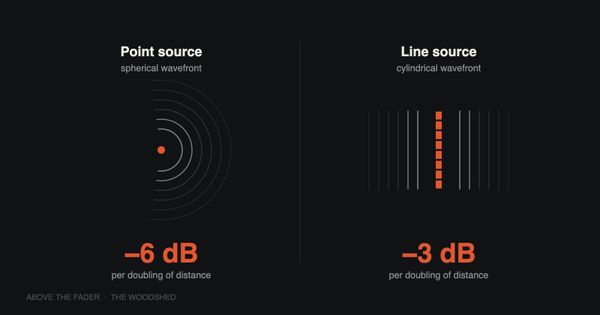
The first tax is level. A point source loses 6 dB per doubling of distance, and even a well-behaved line array in its far field is headed the same direction. Chase the back of a 150 meter field from the stage alone and the arithmetic turns ugly: the level you'd need at the front rows to deliver a respectable number at the back is somewhere between a liability claim and a war crime. The people down front are not a pressure buffer. A tower 90 meters out that only has to cover the last 60 meters lets everyone live at roughly the same SPL, which was the whole promise of the ticket.
Put numbers on the level tax. Say the mains deliver a healthy 106 dB at 10 meters, mix position numbers at a mid-size festival. Inverse square takes 6 dB per doubling: 100 at 20 meters, 94 at 40, 88 at 80, and the blanket kid at 160 meters is theoretically at 82 dB, which on a windy night with a crowd in the way is a clock radio. To hand her 100 dB from the stage alone you'd need 124 at 10 meters, which means the first thirty rows are getting their internal organs reorganized and the local authority is revoking your license mid-set. A tower at 100 meters that covers the last 60 lets the whole field live within a few dB of the same number. That's the entire pitch, and no amount of array sophistication repeals it; a line array's cylindrical-ish behavior postpones the arithmetic, it doesn't cancel it.
The second tax is tone, and it's the one people forget. Air is a low-pass filter. Atmospheric absorption, the ISO 9613-1 kind, is negligible where the bass lives and brutal in the top octaves, and it gets dramatically worse as the air dries out. Run the standard's own math at 20 degrees C: around 1 kHz the air eats well under a dB per 100 meters, a rounding error. At 10 kHz and 50 percent humidity it eats on the order of 15 to 20 dB per 100 meters, and in genuinely dry air it's worse. That is not a gentle tilt you fix with a high shelf; by 120 meters the hi-hat simply did not survive the trip. And the cruel joke is that cranking the mains' HF to compensate fries the first 30 meters of audience to deliver a merely dull result at 100. The tower isn't just a level solution. It's the only way to put actual air, the frequency kind, back into the far field, because it shortens the trip the fragile octaves have to make.
There's a third, unofficial tax that the models politely ignore: the audience itself. A few thousand bodies are an absorptive, scattering carpet exactly where the sound needs to graze, and the grazing path over a crowd eats mids and highs in ways that vary with how packed the field is and whether the back half is standing or sitting on blankets. The empty-field prediction from the afternoon walk-out is the best case the show will never see again. One more reason the far field needs its own sources: by the time the wavefront has skimmed a hundred meters of haircuts, it needs more than a level top-up, it needs its spectrum back.
So we hang more boxes in the middle of the crowd, on purpose, and buy ourselves the original problem of this column: multiple sources, one listener, and arithmetic about who arrives when.
Two arrivals, one listener
Here's what's at stake when two sources carry the same signal to the same ears at slightly different times. The two waveforms sum. At frequencies where the offset is a whole number of periods, they add. At frequencies where it's a half period off, they cancel. The result is comb filtering: a series of notches marching up the spectrum, with the first notch at 1 over twice the time offset, and the rest at odd multiples of it.
Put numbers on it, because the numbers are vicious. A 1 millisecond offset puts the first cancellation at 500 Hz, with notches every kilohertz after that. Deep ones, too: equal levels means theoretically total cancellation at the notch frequencies. A tenth of a millisecond, which is 34 millimeters of position, parks the first notch at 5 kHz, which is why two cabinets a hand's width out of alignment sound like someone pulled the presence out with pliers. The rule of thumb the system world lives by is the quarter wavelength: two sources sum usefully only while their offset stays within a quarter cycle of the frequency in question. At 100 Hz that's a forgiving 2.5 milliseconds, call it 86 centimeters. At 1 kHz it's a quarter of a millisecond, under 9 centimeters. At 10 kHz it's 25 microseconds, which is 8.6 millimeters, which is why nobody on earth has two displaced full-range sources perfectly summed across the band, anywhere, and anyone who claims otherwise is selling something.
And the comb moves when you do. The offset between two fixed sources depends on where you stand, so every step across the overlap zone slides the notch pattern up or down the spectrum. That's the swooshing, phasing character of walking a badly overlapped field: you're strolling through an interference pattern, playing your own head like a wah pedal. Standing still, a 9 millisecond offset reads as a vague hollowness; walking, it announces itself. It also explains the one mercy of the problem: a listener parked at one spot mostly hears one fixed comb, and the ear is decent at listening through a static coloration. It's the spatial variation that makes a field sound broken.
Sit with that for a second, because it reframes the whole job. Perfect alignment between a main hang and a tower exists at exactly one point in space. One. Everywhere else in the coverage overlap, geometry guarantees the arrival times differ, and the only questions are by how much and whether the ear will forgive it. System tuning is not the pursuit of perfection; it's the strategic placement of the compromise.
The ear's grace period
The reason any of this works at all is that the ear is not a measurement microphone. It runs a remarkably specific policy on duplicate arrivals, documented since Helmut Haas's work in 1949, and the whole trade of delay systems is built inside its loopholes.
The policy exists because evolution tuned the ear for rooms and forests, where every direct sound arrives trailed by a spray of reflections carrying the same content slightly late. A hearing system that reported every reflection as a separate event would be useless; one that fuses them and localizes on the first wavefront tells you where the thing actually is. We exploit a 200,000 year old reflex every time we hang a delay.
The policy has zones, and they depend on the material. Sharp clicks fuse only out to a few milliseconds; speech holds together to around 40 or 50; dense music can stay fused toward 100. The working zones for our purposes: Keep two arrivals within about 2 milliseconds of each other and the ear fuses them into one event located somewhere between the sources, a blend. From about 2 to 5 milliseconds, fusion holds and something better happens: the image snaps to whichever source arrived first, regardless of the second one being there at all. From roughly 5 to 30 milliseconds the effect gets almost unbelievable: the arrivals still fuse into a single event, localization still belongs to the first arrival, and this holds even when the late arrival is up to 10 dB louder than the early one. Read that again. The ear will point at the quieter, earlier source. Past the window, the deal collapses: somewhere beyond 30 to 50 milliseconds for speech, and up around 100 for some music, the late arrival detaches into an audible echo and the illusion is dead.
That 5 to 30 millisecond window with 10 dB of level amnesty is the entire business model of the delay tower. It's why the trick of setting a tower's delay slightly long, a handful of milliseconds past the geometric sync time, is standard practice: the mains now arrive first everywhere in the tower's coverage, the ear assigns the image to the stage, and the tower turns into an invisible level and HF subsidy standing in the middle of the crowd. The kid on the blanket points at the band while most of the energy hitting her head comes from a scaffold ten meters behind her. Done right, a delay tower is the best magic trick in live sound: tens of thousands of watts that do not exist perceptually.
Done wrong, each error has its own signature. Miss inside the fusion zone and you don't get echo, you get the comb: that hollow, phasey, position-dependent tone from the last section. Miss long and the image migrates to the tower, which audiences can't articulate but absolutely notice, the band sounding like it's playing from a lighting truss. Miss really long and you've built a slapback machine covering three thousand people.
Aiming the lie
So the alignment procedure is really three decisions wearing a trench coat.
Decision one: where is the alignment point? Perfect sync exists at one spot, so choose it like it matters, because it's the center of the forgiven zone, with error growing in every direction as geometry pulls the two path lengths apart. The textbook answer is the middle of the tower's coverage area, biased toward where the valuable ears are. The pragmatic answer at a festival is usually a compromise between the mix position behind the tower, the densest crowd, and wherever you can physically stand with a rig during tuning.
The geometry has one genuinely elegant feature, worth knowing because it tells you where to worry. Directly behind the tower, on the stage-to-tower line, the path difference between mains and tower is constant: walk straight back and both paths grow by the same meters, so an alignment that's right at 110 meters is still right at 140, on that line. The error lives off to the sides. Drift laterally out of the overlap's center line and the two path lengths diverge at different rates, the offset opens up, and the forgiven zone turns out to be a stripe running downfield from the tower, not a circle around the alignment point. Which is a real argument about tower placement: a tower aimed down the middle of its own coverage forgives; listeners catching the overlap from the flanks get the arithmetic at its worst.
Decision two: how much extra do you give it? The precedence window says the tower should be late on purpose, enough that the mains win the localization race across the tower's whole coverage, not so much that you drift toward the echo cliff. In practice the working range is a few milliseconds up to roughly ten, and the right value depends on how much natural offset the geometry already creates across the zone. This is also where level discipline comes in: the 10 dB amnesty is real but finite, and a tower run grossly hot will eventually out-shout the precedence effect no matter what the clock says.
Decision three: what do you align with? Ears and tape measures get you to the neighborhood; the measurement rig gets you the house number. A dual-FFT analyzer comparing the console reference against a measurement mic at the alignment point hands you the propagation delay directly, main hang first, then tower, and the difference is your number before the deliberate offset goes on. The tape measure deserves more respect than it gets, though: at 2.9 milliseconds per meter, a laser rangefinder and ten seconds of arithmetic will land you within a millisecond or two of what a measurement rig says, and on a multi-ring festival system the rangefinder pass is how you sanity-check that nobody fat-fingered a delay matrix entry by a factor of ten. With multiple rings of towers, reference every ring to the mains, not to the ring in front of it, so errors don't compound their way down the field. This is also the step where the tonal half of the job happens, because per van Veen's four requirements a tower has to match the mains in level, arrival time, and tonal character, and manage its low end, before it disappears. The tower is reproducing a signal the mains deliver after 100 meters of air filtering; feed the tower the same flat drive and it'll sound like a different, brighter PA bolted into the field. The delay fill should sound like the mains sound at the tower, plus clean HF, not like the mains sound at the front fill.
And low end: below a couple hundred hertz, wavelengths are long enough that the tower's energy and the mains' energy interact over huge areas and the quarter wavelength rule is actually achievable, which cuts both ways. A tower running full range can either reinforce the field's low end or carve slow-moving trenches through it. Lots of designers high-pass towers generously and let the mains own the bottom, because the mains already deliver bass at the back just fine; it was only the top of the spectrum the air confiscated.
The alignment that rots
Everything above describes one moment of air. Now put the show in it.
Run the full worked example: towers 100 meters out, aligned at a 30 degree soundcheck, show peaks at 12 degrees. The propagation from stage to tower zone went from 286.1 to 295.4 milliseconds while your delay setting sat still, so the mains now arrive just over 9 milliseconds later than the alignment assumed, relative to the tower. Your deliberate few milliseconds of precedence offset just got eaten and then some; depending on what you dialed in, the tower may now be arriving first. The image slides off the stage into the scaffolding, and the overlap zones turn to comb. Nobody touched anything. The field just cooled.
The drift is linear and predictable, about 0.17 percent of the delay per degree C, which sounds precious until the delays are 300 milliseconds long and the swing is 15 degrees. Outdoor summer festivals in dry climates routinely see 15 to 20 degree swings between check and headliner. That's the difference between an alignment and a rumor of one. Modern system processors will scale every delay in the rig from a temperature you type in, some rigs hang a weather station on the network, and the unglamorous manual version, re-shooting the towers during the first songs of the headliner, has saved more shows than any plugin. Van Veen's blunter advice for big-swing situations: re-evaluate the delays, and when that can't be guaranteed, design so you depend on them less.
The evening also runs a quieter experiment on your top end. As air cools toward the dew point, relative humidity climbs, and the ISO 9613-1 absorption that was strangling the HF at 3 pm in 30 percent humidity relaxes its grip. The far field gets audibly brighter after dark with nobody touching an EQ, and the engineer who tuned a crispy afternoon system discovers the night version has teeth. The drift isn't only in time. The air's whole transfer function is on the move, which is one more argument for treating the first two songs of the headliner as a measurement opportunity instead of a victory lap.
Temperature has a second, sneakier act: it doesn't stay uniform. After sunset the ground cools and the air stratifies, cold and slow near the grass, warmer and faster up high. Sound leans toward the slow side, so the wavefront bends downward, which is why shows carry further and complaints from the next village arrive after dark. Wind does the same thing with shear, faster air aloft tilting the wavefront down when you fire downwind and up when you fire into it, which can swing far-field level by whole dB and smear arrival structure in ways no static delay fixes. None of this shows up at the processor. All of it shows up at the fence line.
Closer to home: subs and mains
If towers feel like somebody else's giant problem, the same physics runs the most ordinary alignment in the business: subwoofers to mains, every show, every room.
The crossover region is a zone where two displaced sources, the flown array and the ground stack, carry the same frequencies at comparable level, which is exactly the two-arrivals problem, just narrowband. At a 90 Hz crossover the wavelength is 3.8 meters, the quarter wavelength budget is about 2.8 milliseconds, and the typical geometry, subs on the deck meters in front of and below the hang, spends most of that budget before you touch anything. Get the arrivals wrong by half a cycle at crossover and the two cabinets dig a hole through the one octave the audience came to feel. The fix is the same ritual in miniature: measure both paths at a sensible reference position, align the phase through the crossover region rather than obsessing over one impulse peak, and accept that the alignment holds along a line in space, not everywhere, because it can't hold everywhere.
A terminology cleanup belongs here, because the trade uses three words interchangeably that physics doesn't. Polarity is a swap of plus and minus, every frequency flipped at once, free and instant. Delay is time, all frequencies shifted equally. Phase at a single frequency is the thing you're actually trying to fix at a crossover, and both of the other two move it, which is why the polarity button sometimes "fixes" a sub alignment: 180 degrees of flip plus a bit of delay can land the crossover region close enough. It's also why "we time aligned it with the polarity switch" is a sentence that should make you reach for the analyzer. The flip got the 90 Hz region to sum; what it did two octaves up, where the same wavefronts also overlap, is anyone's guess until someone measures it.
Which is also the context for reading "time aligned" on a spec sheet with appropriate suspicion. Alignment is not a property a box can ship with. It's a relationship between sources, a position, and this afternoon's air. A manufacturer can align a crossover inside one enclosure, and good ones do; nobody can sell you an alignment between your mains and your subs and your towers at your show at your 10:45 pm temperature. That one you make yourself, and remake.
What you can take back to the desk
First, carry the two numbers that do all the work: 2.9 milliseconds per meter, and 0.6 meters per second per degree. The first sets every delay in the rig; the second tells you how fast your settings are rotting. A 300 millisecond delay drifts about half a millisecond per degree. Do that math once per gig and temperature stops being a mystery and becomes a line item.
Second, align at the temperature you'll perform at, or plan to touch it again. A 3 pm alignment for a 10 pm show in a continental summer is a draft, not a final. If the processor offers temperature compensation, feed it a real number at show time; if it doesn't, budget five quiet minutes during the opener to re-shoot the main-to-tower offset. The audience will never know you did it, which is the point.
Third, be deliberate about the precedence offset instead of cargo-culting a number. The window is wide, a few milliseconds to around ten, and the right value covers your geometry's natural spread with margin for drift in the direction you expect. Cooling air slows propagation and pushes the mains later, eating your offset, so on a field that will cool, err long.
Fourth, high-pass the towers and match their voicing to what the mains actually sound like at the tower, not to the system reference curve. The tower's job is to give the far field back its top octaves and a few honest dB, not to be a second PA with opinions.
Fifth, let the far field be mono, or close to it. Stereo at the mix position is a nice afternoon; at 120 meters, panned content means two different source positions per instrument, which in delay-tower land means two different alignment problems per instrument, and listeners out there sit so far off the stereo axis that the image was never going to survive anyway. Feeding towers a mono or heavily summed mix costs the back field nothing it actually had and removes a whole layer of interference you'd otherwise be managing. Plenty of the biggest touring systems in the world quietly run exactly this way.
Sixth, when the far field sounds wrong at 11 pm and the trace at FOH looks fine, believe the field. FOH sits in one point of a system whose geometry spans hundreds of milliseconds; combs and image drift live out there, between the sources, where nobody with a laptop is standing. Walk it. The two arrivals will tell you which one moved.
The rig didn't come loose and the processor didn't glitch. The air the show travels through at 10:45 is simply not the air you measured at 3, and every number in the delay matrix was a bet on the weather. Align late, align warm or compensate, keep the mains winning the race by a polite handful of milliseconds, and the best compliment you'll get is nobody noticing the towers exist. In this corner of the trade, inaudible is the standing ovation.
Above the Fader
Sauce
- Precedence effect - Wikipedia
- Speed of Sound in Air - HyperPhysics
- Calculation of the Damping of Air (ISO 9613-1) - Sengpiel Audio
- Four Requirements For Deploying Delay Loudspeakers - Merlijn van Veen, Live Sound International (Feb 2017)
- Using Delays to Enhance the Sound System - ProSoundWeb
- A Public Address Time Alignment Instrument - J. Angus & R. Claxton, Institute of Acoustics
Featured photo by Danny Howe on Unsplash.